My beloved Mac has gone wonky on me. On startup, the Suitcase fails, System Preferences crashes when opened, and Safari crashes when opened. Lyx, my LaTeX thesis writing program, also won't work.
Thank goodness it works in Safe Mode. But then I don't get the Internet.
Actually, that might do wonders for my productivity.
Sigh. Another hump in the road.
Monday, February 16, 2009


Keeping Connected to Old Friends
I have just put a batch of homemade chocolate pudding in the fridge to cool. Yum. It reminds me of my dad, who used to make it when I was little.
That leaves me with twenty minutes to attack a topic.
I have found that when I send an old friend a Facebook message asking how they are doing, I never get more than "fine" back. If I send an email, I might get a few sentences. But if I really want to keep in touch with people, I have to call.
So I do. When I do my laundry, I call a friend while the dryer runs. I start at the top of my phone list and work my way around, so all friends get talked to... eventually. How quickly depends how often I do my laundry. If they don't pick up, I leave a message and call the next one. It's a two-fer special, because then I get a call back the next day.
This system works really well for me, and I love hearing stories about how lives are going. It's especially interesting for me because only two of my friends have chosen grad school, the rest have jobs and lives and husbands and wives and - gulp - kids now. I get to vicariously pretend to have a paycheck and a house, and they get to relive the glory days of late nights and ordering in pizza.
It's even better when they come visit. Last week, I had my first visit from a friend I knew in undergrad. It's been nearly two years since I graduated, just for background. My friend has now married his girlfriend, moved to Texas, and works for National Instruments. He was teaching a class on how to use National Instrument's software for employees in a company that is in my area. So we got together, I showed him around campus and took him out to dinner. I was very proud to show off my work and my campus, and over dinner he confessed that he was a little jealous that he didn't have the flexibility that being a student offers. I think, of course, that he was jealous of the Very Cool Stuff that I build. :) But I digress.
The funny thing is that I was going to say that I was jealous of his world - sometimes I feel a little like I've been left behind by my friends. He seems like he's moved up a stage in life - he has a wife now, a car, a job at work with projects directly applicable to the real world. Did I mention he doesn't live in a dorm. And, for crying out loud, he does not have to take TESTS anymore?
So to each his own, and honestly I wouldn't trade what I am doing for any of my friend's lives. I may not have all those "grown-up" type things now, but I will eventually graduate. And when I do take on those adult responsibilities, I will be doing it with an advanced degree in a field I love that I can apply to whatever career path I fancy.
But sometimes these conversations with old friends leave me with a dilemma. I have some friends who are not where they want to be in life. One friend living in a city she hates because her husband got a job there. Life is especially hard for those with degrees in fields that are really tough to get into right now - my journalism friends come to mind (one of whom just got laid off from a newspaper job she got after graduation). One friend, who so inspires me, was the first one of her family to ever go to college, much less get a degree. But instead of escaping small-town life like she wanted, she gave up some of her dreams to care for her mother. Now that her mom is better she is stuck in a crappy job in her hometown, just like she never left.
So my dilemma is this: how do I tell stories about what I am doing now (graduating with a Master's from World's Best School) and places I have been (Singapore, London, Alabama) without sounding arrogant? How do I get across the point that I am still so very proud of my friends, even if they don't have the same opportunities or make the same choices I did?
How do you brag about your life to someone who is not happy with theirs, without sounding like a jerk?
Sunday, February 15, 2009
Cheapness of Grad Students
Look, I realize grad students are cheap.
It's the nature of the game. Everybody's on stipend, here. Unless you have an alternate source of income, (I'm looking at you, married-with-working-spouse guys in the lab) we are all about the same. I have side gigs, but that's not the point.
1) I happily consume my free pizza at student seminars with everyone else, and I volunteer to help prepare food for coffee hour for grad students.
2) I use student discounts wherever possible (hello, student card). Yay for 15% off bus tickets at Greyhound!
3) I get my textbooks from half.com, and when the professor says we can use the previous edition I usually do that.
4) I carefully plan my trips and adventures, and don't mind sharing coed hotel (or hostel, as in London) rooms with friends.
5) I got my extra computer monitor and my TV off of Craigslist. Funny story, the monitor. For a pristine 17" widescreen flat panel, I paid $20. It "seemed to be a fair price for a used monitor" said the ivy league senior with daddy's money.... can we say out of touch with the real world? But hey, I didn't complain...
These are all good things, people. But there are certain places I'd like to point out to my fellow grad students I've met along the way that cheapness is not acceptable:
1) Don't take four pieces of the cake and a tupperware full of the fruit I just spent the last 45 minutes helping cut into individual portions. Especially when there are 150 more people behind you who'd like to get a snack. In fact, please don't bring tupperware to events with free food and leave. Stay for the flippin' event!
2) Don't ask me to pay for half of the gas to get to the grocery store, when you were going anyway. That's just rude to ask of a friend - if you have to calculate mileage, please just let it rest...
3) Buy the textbook, for crying out loud. If you are in grad school, you should be taking the class because it is at least somewhat useful, or interesting. The books should be useful. And don't get the "international" paper-back version they sell on eBay, the paperbacks get torn within the semester, and you want a reference.
4) Instead of making the trip awkward for all those involved because you are nickel- and dime-ing every meal and expense, try going on less trips and having a bit more to spend on each. That way, you won't make us buy you a water at the basketball game.
5) Don't, for heavens sake, steal the batteries from the remotes in the TV lounges provided for students. Or the HDMI cable. Or the chairs in the lounge. Just let me watch a game once in a while, with all equipment present and accounted for...
Please and thank you.
Friday, February 13, 2009
On the Blending of Love and Science
Oh sweet rainbows. Could there be any more chick flicks on TV this weekend?
I have been thinking today about the blending of love and science. Does the scientific approach have any place in relationships, and as women in science do we have a different experience?

In thinking about the various relationships and adventures in love I have observed in my friends and colleagues, there are two things I want to discuss. One is the difference I see between those in the sciences and those not, and the other is the difference I see between college and graduate school.
The difference between college and graduate school is pretty obvious. Holycrapeverybodygotmarried. I think this partly has to do with the fact that I did my undergrad in the middle of the bible belt. It doesn't have so much to do with religion, but I think in the South/Midwest the average marrying age is younger, and it is quite common for people to get married quickly out of highschool and college. I have bought an incredible number of wedding gifts for my friends from undergrad in the past three summers - I am thrilled that they are all happy, but selfishly I must say that I hope some cosmic tallybook is recording all of that for use when I get married someday. I recently passed a milestone on Facebook, in that 51% of my friends are now engaged or married. Nothing like going back for homecoming to find your boyfriend from freshman year is married with a one-year-old to make you feel like people have moved on without you. :)
But I can see the difference being married makes on those in grad school. There are several guys in my lab who are married, one who is engaged, and several who are in long-term relationships. As an aside, one of the married guys has a newborn, and his wife brought in the wee one wrapped in blankets to lab one day to introduce. My maternal instincts kicked in so strongly it wasn't even funny - I nearly decided to quit grad school and adpot....
The common thing I see among these friends is that they seem more balanced, more grounded. Being married has given them a better perspective - school doesn't mean any less to them, but they realize that there is more to life than the science. I think it also helps to go home to your significant other at the end of the day, because you get unconditional support and reassurance from them, recognition that yes, even if your science flopped that day, you are still amazing. This doesn't mean single people can't be grounded and confident, I'm just staying I think it's a bit harder.
Now, a point about the difference I see between those in science and those not. I honestly expected as a freshman in college that girls in engineering would have less drama in their love lives. We are supposed to be logical, right? Some of my best friends from college were girls (most definitely not engineers) I met in the dorm, who I grew very close to and who provided an outlet for me outside my school and science endeavors. These girls and I supported each other, and I was there with them for many an ice-cream binge after a breakup, or comforting sessions after somebody fell apart crying in the bathroom. What I am saying is, there was drama a-plenty. One of these girls is now married, and another is engaged.
I fully expected that the girls I knew in engineering would handle their love lives differently. They would make better choices, I thought, because they could rationally weigh their decisions. Well, as you can guess, a big 'ol "HA!" to that idea. There was just as much drama if not more than with my girls outside the sciences. Same thing in grad school. I suppose no matter how rational you think you are, the emotions will get you every time. Perhaps, even, the girls in engineering were less prepared to deal with the emotions - we get very little practice in our field at the emotional side of things.
So back to my original question: Does the scientific approach have any place in love, and as women in science do we have a different perspective or experience of love?
Well, gees, who am I to say?
I am going to propose that yes, scientific approach does help in love, as does education of any sort. Being able to take a step back and think for a minute does wonders to guard against rash decisions. I am going to cling to my perhaps naive notion that you can save yourself a world of hurt if you just take a minute to evaluate what you are doing, no matter what the area.
Do women and men in science experience love differently? I know for myself, I appreciate the people in my life who love me even more because I know it's not logical - and I love them back without having to explain it, or to justify it. I pride myself on being logical, but when a boy came along I really fell for I threw all of that out the window. So I guess what I'm saying is I think love is universal, and you can't do a flippin' thing about it.
So what do you think, internet? Am I just young and nerdy and have no idea what I'm talking about? What have been your experiences - has science affected the relationships in your life? Or does just asking that question kill the romance?
Oh, and a Happy (now that I have completely over-analyzed it) Valentine's Day to you -
I have been thinking today about the blending of love and science. Does the scientific approach have any place in relationships, and as women in science do we have a different experience?
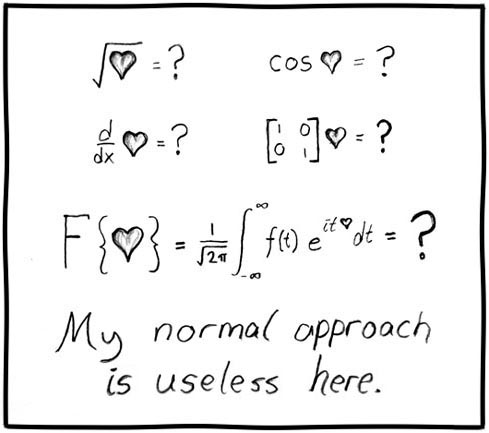
In thinking about the various relationships and adventures in love I have observed in my friends and colleagues, there are two things I want to discuss. One is the difference I see between those in the sciences and those not, and the other is the difference I see between college and graduate school.
The difference between college and graduate school is pretty obvious. Holycrapeverybodygotmarried. I think this partly has to do with the fact that I did my undergrad in the middle of the bible belt. It doesn't have so much to do with religion, but I think in the South/Midwest the average marrying age is younger, and it is quite common for people to get married quickly out of highschool and college. I have bought an incredible number of wedding gifts for my friends from undergrad in the past three summers - I am thrilled that they are all happy, but selfishly I must say that I hope some cosmic tallybook is recording all of that for use when I get married someday. I recently passed a milestone on Facebook, in that 51% of my friends are now engaged or married. Nothing like going back for homecoming to find your boyfriend from freshman year is married with a one-year-old to make you feel like people have moved on without you. :)
But I can see the difference being married makes on those in grad school. There are several guys in my lab who are married, one who is engaged, and several who are in long-term relationships. As an aside, one of the married guys has a newborn, and his wife brought in the wee one wrapped in blankets to lab one day to introduce. My maternal instincts kicked in so strongly it wasn't even funny - I nearly decided to quit grad school and adpot....
The common thing I see among these friends is that they seem more balanced, more grounded. Being married has given them a better perspective - school doesn't mean any less to them, but they realize that there is more to life than the science. I think it also helps to go home to your significant other at the end of the day, because you get unconditional support and reassurance from them, recognition that yes, even if your science flopped that day, you are still amazing. This doesn't mean single people can't be grounded and confident, I'm just staying I think it's a bit harder.
Now, a point about the difference I see between those in science and those not. I honestly expected as a freshman in college that girls in engineering would have less drama in their love lives. We are supposed to be logical, right? Some of my best friends from college were girls (most definitely not engineers) I met in the dorm, who I grew very close to and who provided an outlet for me outside my school and science endeavors. These girls and I supported each other, and I was there with them for many an ice-cream binge after a breakup, or comforting sessions after somebody fell apart crying in the bathroom. What I am saying is, there was drama a-plenty. One of these girls is now married, and another is engaged.
I fully expected that the girls I knew in engineering would handle their love lives differently. They would make better choices, I thought, because they could rationally weigh their decisions. Well, as you can guess, a big 'ol "HA!" to that idea. There was just as much drama if not more than with my girls outside the sciences. Same thing in grad school. I suppose no matter how rational you think you are, the emotions will get you every time. Perhaps, even, the girls in engineering were less prepared to deal with the emotions - we get very little practice in our field at the emotional side of things.
So back to my original question: Does the scientific approach have any place in love, and as women in science do we have a different perspective or experience of love?
Well, gees, who am I to say?
I am going to propose that yes, scientific approach does help in love, as does education of any sort. Being able to take a step back and think for a minute does wonders to guard against rash decisions. I am going to cling to my perhaps naive notion that you can save yourself a world of hurt if you just take a minute to evaluate what you are doing, no matter what the area.
Do women and men in science experience love differently? I know for myself, I appreciate the people in my life who love me even more because I know it's not logical - and I love them back without having to explain it, or to justify it. I pride myself on being logical, but when a boy came along I really fell for I threw all of that out the window. So I guess what I'm saying is I think love is universal, and you can't do a flippin' thing about it.
So what do you think, internet? Am I just young and nerdy and have no idea what I'm talking about? What have been your experiences - has science affected the relationships in your life? Or does just asking that question kill the romance?
Oh, and a Happy (now that I have completely over-analyzed it) Valentine's Day to you -
Thursday, February 12, 2009
Adventure for the Day
A couple weeks ago, the girl who sits across the cubicle wall from me in the office found evidence of mice in her bag of almonds. After this revelation, the whole office was prompted to check their food at their desks.
I would never have guessed the amount of food that started showing up. People pulled out apples, bananas, hot chocolate mix (okay, maybe that was me), protein bars, Hershey's kisses, popcorn, lunchables (yes, lunchables, of the kiddie variety... apparently they were on sale at ShopRite), and all manner of other goodies. We could have fed an army.
Lots of people had mice nibbles in their food, and droppings in their drawers. The mice (or one very dedicated mouse) seemed to particularly like chocolate. Good taste, I say.
So we called facilities to come set traps, but I thought they never came. In the meantime we all locked down our desks, and kept a sharp eye out. Although a little furry streak was spotted a couple times, usually late at night when it was uncorroborated, no mouse was ever caught.
And then my cubicle started smelling a little... off. My cube mates cleaned out their desks, and I made sure all my gym clothes were washed. One student never sits at his desk, so we were afraid he had something molding away in there, but we didn't want to rummage through his drawers without permission.
But then today, the girl who originally sounded the alarm (who sits over the cubicle wall from me) wandered over to ask if we thought something smelled off. I said it did, but we couldn't figure out where it was coming from. Have you checked the traps, she asked? Cue dumb looks.
Turns out facilities people had set traps, I just didn't notice. And there was a mouse in one. RIght under my desk, in the corner. I poked my head under, and there he was. Staring back at me.
I am, unfortunately, too squeamish to wiggle my way under a desk and retrieve a three day old dead mouse which looks at me from cold, unblinking eyes. One of the other boys carted it off, and I think he just earned himself lunch from me.
And the girl who started it all, who blew the whistle and then discovered the source of the smell, asked the guy in her cubicle why he hadn't mentioned the faint odor. "Because," he said, "I thought it was you....".
Wednesday, February 11, 2009
New Adventures of the Shooting Variety
In the spirit of my "wishes" post, I added a new class this semester.
Hello, archery! Of the recurve bow variety. I look exactly like this:

This activity has added an new and unexpected dimension to my day. As in, when I get up in the morning and I go to wash my hair, my arms talk to me. Quite clearly. They say, "um, no." and refuse to make it up to my head. And after I clear that little hurdle, my back chimes in. "Oh, that bookbag of yours on the floor? Yeah, it wants to stay there. It's too far of a distance to lift to your shoulder," says my helpful back. And now that I am irritated that the bookbag is in cahoots with my muscles, I realize that my coffee is also in on the game. It has relocated itself to the top shelf, which requires both arm and back muscles to stretch to reach.
At this point I cry foul, and leave for lab with wet hair, my bookbag carried at the level of my knees, and without my usual caffiene buzz. The whole kaboodle is modifying my normal routine a little bit, but really what's a few more voices talking to me amongst the usual complement in my head? :)
I was really excited to get into the class, because I was only on the waitlist. The teacher asked us the first day if we were right- or left-handed, and I (as usual) had to cause problems by saying I am both. This is true - I write left-handed, but play sports and do most other things right-handed. I wasn't sure which applied.
So I did the whole first class using a right-handed bow. When we were practicing how to draw, I suddenly realized quite clearly that I was not, in fact, right-handed. In hind sight this should have been obvious because (in spite of the fact I do most things right-handed) I do, you know, write with the left hand. That's kinda the definition of left-handed. Once again, my arms piped up to help me with this concept. "Wrong hand! wrong hand!" they yelled. I felt all discombobulated, I kept sighting out of the wrong eye, and my weaker arm was forced to be the draw arm.
So I had to cause problems yet again and ask for a left-handed bow in the next class. The result being, as I said, both halves of my body are equally unhappy.
But I am looking forward to improving. And, not only is this something I have always wanted to try, but it is also a new adventure in extra-curricular activities (see helpful comments on the state of friends in my life). In fact, my new partner Michael for the class is assigned to help me string my bow at the beginning of each session. I let him and his gorgeous smile help me more than I needed the first day of class...
But next class, I may not be pretending. I think my arms are planning a coup... I've kept this a secret from my back, but it has intelligence everywhere.
Hello, archery! Of the recurve bow variety. I look exactly like this:


This activity has added an new and unexpected dimension to my day. As in, when I get up in the morning and I go to wash my hair, my arms talk to me. Quite clearly. They say, "um, no." and refuse to make it up to my head. And after I clear that little hurdle, my back chimes in. "Oh, that bookbag of yours on the floor? Yeah, it wants to stay there. It's too far of a distance to lift to your shoulder," says my helpful back. And now that I am irritated that the bookbag is in cahoots with my muscles, I realize that my coffee is also in on the game. It has relocated itself to the top shelf, which requires both arm and back muscles to stretch to reach.
At this point I cry foul, and leave for lab with wet hair, my bookbag carried at the level of my knees, and without my usual caffiene buzz. The whole kaboodle is modifying my normal routine a little bit, but really what's a few more voices talking to me amongst the usual complement in my head? :)
I was really excited to get into the class, because I was only on the waitlist. The teacher asked us the first day if we were right- or left-handed, and I (as usual) had to cause problems by saying I am both. This is true - I write left-handed, but play sports and do most other things right-handed. I wasn't sure which applied.
So I did the whole first class using a right-handed bow. When we were practicing how to draw, I suddenly realized quite clearly that I was not, in fact, right-handed. In hind sight this should have been obvious because (in spite of the fact I do most things right-handed) I do, you know, write with the left hand. That's kinda the definition of left-handed. Once again, my arms piped up to help me with this concept. "Wrong hand! wrong hand!" they yelled. I felt all discombobulated, I kept sighting out of the wrong eye, and my weaker arm was forced to be the draw arm.
So I had to cause problems yet again and ask for a left-handed bow in the next class. The result being, as I said, both halves of my body are equally unhappy.
But I am looking forward to improving. And, not only is this something I have always wanted to try, but it is also a new adventure in extra-curricular activities (see helpful comments on the state of friends in my life). In fact, my new partner Michael for the class is assigned to help me string my bow at the beginning of each session. I let him and his gorgeous smile help me more than I needed the first day of class...
But next class, I may not be pretending. I think my arms are planning a coup... I've kept this a secret from my back, but it has intelligence everywhere.
Tuesday, February 10, 2009
Outlier: Entrepreneurship
I had the opportunity to attend an entrepreneurship panel this week, and it was fascinating. They had three current MBA students on the panel, who had all started one or more successful businesses.
One started a hedge fund and managed a billion dollar portfolio by age 25, and then he got tired of that, sold it, and started a company in Brazil doing the same kind of thing these guys do, although that's not his company. They give out paper hangers for free to dry cleaning companies, paid for by advertising on the hangers. It's green, saves the dry cleaners money, and the advertisers know the item will be looked at in the person's closet for weeks.
The other guy started a resale consumer goods company in the UK selling through eBay and Amazon and his own website. Then he got tired of that, and started something else, I've forgotten what.
The last guy started his first company while he was in college, trying to make beer money. He and his friends bought domain names in English that translated to common things in India, then resold them. Domain squatting, I think that's called. It worked when he did it because the Internet and globalization was new, but he got out of that because, well, there are only so many domain names. So then he started flipping houses in Chicago, and morphed into real estate.
And all these guys are still in their 20s! It's quite humbling. I liked hearing their life stories, although I was a little disappointed none of the businesses they started were technical in nature. It's a bit different to start a technology/engineering type company than to start selling things on eBay. But in the end, hey, if it makes you money what does it matter.
My favorite part was the questions and the answers. A lot of the things they said, I already knew.
1) It takes incredible dedication and focus to start a company - it's a high risk, high reward proposition, not for the weak of heart or mind.
2) You have to be really cheap. Nickel and dime every expense to minimize absolutely every cost. The only thing which you should not skimp on is people - if you have partners, pay them what they are worth. Pay them more than what they think they are worth, even. It's worth it to have good people who won't walk out on you.
3) It's not the idea that matters. Ideas are easy, every person who thinks can come up with ten company ideas a day. It's picking the right one that matters, and the execution. Someone asked the panel how they protect their ideas, and if they worry about someone stealing it. One reply particularly struck me: don't worry, somebody already has your idea, and you probably stole it from someone else. There are very few things nobody has thought of. And if they can execute it better than you can, then they are the ones who should be doing it, not you. And if you can execute better, then you shouldn't be worried.
45) It takes a certain kind of person to be an entrepreneur. It runs in the blood, you might say. These kind of people have the ability to focus to the exclusion of all else, a drive to be creative and innovate. They can't stand the idea of an industry job. Some just love the process of starting the company, and will work in any field. Some are motivated by the idea and could care less about the process. But all of them are passionate.
This entrepreneurship thing runs in my blood, for better or worse. I kind of knew this in college, but it has really solidified in grad school. I am one of those people who thinks of company ideas by the handful. I can't think of a single person I'd rather work for than myself. I don't mind not having job security in the form of a company salary. I know my mind, my skills and my ideas are security enough - I know I'm good enough to make a living, if not a fortune under the right circumstances.
I say all this because I know it isn't the typical direction a grad student takes. Most engineering students I knew in undergrad took jobs in industry after completion of the bachelor's. A small percentage went to grad school, like I did. Of the few people I know personally who went to grad school, a master's is all they were going for. Either an MBA to help to get a job in engineering management, or rarely an M.S. to get a better salary in an industry job. Only one person I know from undergrad is going for a PhD - and he only decided that because his industry job went away with the economy.
So here I am, going for the PhD. Why? I know it's strange to complete a PhD and not be interested in academia. I stayed for a PhD because it is exciting to me to work on a problem that nobody has solved. In classes, you solve problems, but they are problems with known solutions. How much more valuable to find an interesting, relevant area of research and make a significant contribution. Also, having a PhD from here will give me superb credentials - I can essentially prove myself by just writing my name.
So, surprise, surprise, I'm an outlier in my career path. I want to start my own company. Someday soon, before I leave this school. My favorite part of being here at World's Best School is that I am surrounded by brilliant people in all different fields, the cliche melting pots of minds, ideas, and money. Standing at the front end of an intractable problem is a scary place to be for most, but I do it every day in research. Not so different than standing at the front end of a company that isn't reality yet.
For some outliers like me, it's not scary - it's inspiring.
One started a hedge fund and managed a billion dollar portfolio by age 25, and then he got tired of that, sold it, and started a company in Brazil doing the same kind of thing these guys do, although that's not his company. They give out paper hangers for free to dry cleaning companies, paid for by advertising on the hangers. It's green, saves the dry cleaners money, and the advertisers know the item will be looked at in the person's closet for weeks.
The other guy started a resale consumer goods company in the UK selling through eBay and Amazon and his own website. Then he got tired of that, and started something else, I've forgotten what.
The last guy started his first company while he was in college, trying to make beer money. He and his friends bought domain names in English that translated to common things in India, then resold them. Domain squatting, I think that's called. It worked when he did it because the Internet and globalization was new, but he got out of that because, well, there are only so many domain names. So then he started flipping houses in Chicago, and morphed into real estate.
And all these guys are still in their 20s! It's quite humbling. I liked hearing their life stories, although I was a little disappointed none of the businesses they started were technical in nature. It's a bit different to start a technology/engineering type company than to start selling things on eBay. But in the end, hey, if it makes you money what does it matter.
My favorite part was the questions and the answers. A lot of the things they said, I already knew.
1) It takes incredible dedication and focus to start a company - it's a high risk, high reward proposition, not for the weak of heart or mind.
2) You have to be really cheap. Nickel and dime every expense to minimize absolutely every cost. The only thing which you should not skimp on is people - if you have partners, pay them what they are worth. Pay them more than what they think they are worth, even. It's worth it to have good people who won't walk out on you.
3) It's not the idea that matters. Ideas are easy, every person who thinks can come up with ten company ideas a day. It's picking the right one that matters, and the execution. Someone asked the panel how they protect their ideas, and if they worry about someone stealing it. One reply particularly struck me: don't worry, somebody already has your idea, and you probably stole it from someone else. There are very few things nobody has thought of. And if they can execute it better than you can, then they are the ones who should be doing it, not you. And if you can execute better, then you shouldn't be worried.
4
This entrepreneurship thing runs in my blood, for better or worse. I kind of knew this in college, but it has really solidified in grad school. I am one of those people who thinks of company ideas by the handful. I can't think of a single person I'd rather work for than myself. I don't mind not having job security in the form of a company salary. I know my mind, my skills and my ideas are security enough - I know I'm good enough to make a living, if not a fortune under the right circumstances.
I say all this because I know it isn't the typical direction a grad student takes. Most engineering students I knew in undergrad took jobs in industry after completion of the bachelor's. A small percentage went to grad school, like I did. Of the few people I know personally who went to grad school, a master's is all they were going for. Either an MBA to help to get a job in engineering management, or rarely an M.S. to get a better salary in an industry job. Only one person I know from undergrad is going for a PhD - and he only decided that because his industry job went away with the economy.
So here I am, going for the PhD. Why? I know it's strange to complete a PhD and not be interested in academia. I stayed for a PhD because it is exciting to me to work on a problem that nobody has solved. In classes, you solve problems, but they are problems with known solutions. How much more valuable to find an interesting, relevant area of research and make a significant contribution. Also, having a PhD from here will give me superb credentials - I can essentially prove myself by just writing my name.
So, surprise, surprise, I'm an outlier in my career path. I want to start my own company. Someday soon, before I leave this school. My favorite part of being here at World's Best School is that I am surrounded by brilliant people in all different fields, the cliche melting pots of minds, ideas, and money. Standing at the front end of an intractable problem is a scary place to be for most, but I do it every day in research. Not so different than standing at the front end of a company that isn't reality yet.
For some outliers like me, it's not scary - it's inspiring.
Subscribe to:
Posts (Atom)