Good gracious, is this not straight up magic for data analysis?
Wrangler Demo Video from Stanford Visualization Group on Vimeo.
This would have made my life SO much easier when analyzing data for my Master's thesis...
Found c/o MetaFilter.
Wednesday, February 9, 2011


Tuesday, February 8, 2011
Yoga
In undergrad, I had roommates that used to do Pilates. They convinced me to go with them to a Pilates class exactly twice, and I found it to be thinly veiled torture. I wasn't strong enough or flexible enough to do any of the moves properly, so it primarily consisted of me stumbling through the class trying to imitate the teacher.
My roommates told me it was "relaxing and invigorating." I found it anything but. I much preferred to go out to the workshop and sand on the canoe I was building. Sanding, now THAT is a therapeutic activity.
But two different friends of mine have been raving to me about the yoga classes they are taking. There is a highly-rated yoga studio only a fifteen minute walk from where I live (and, only ten minutes from my office). And I know that yoga is supposed to be really good for you.
So, with some trepidation, this January I started going to some yoga classes with my friends, about one a week. I didn't know what to expect for my first class, but to my surprise it was phenomenal. The teacher was excellent (at least I thought so, though what do I know?), and showed both challenging poses and modified versions for beginners like me. There were all levels of students in the class, and everyone could participate as best as they were able.
Something about the class just really resonated with me - at the end of class, I felt like I had stretched muscles that had sat dormant for a long time, and at the same time challenged the strength of my body. Like I had connected my mind and body and breathing. I don't subscribe to the spiritual aspect of yoga, but calming your mind, noticing how you are feeling internally, and providing your body what it needs is really powerful.
The yoga studio I've been going to is almost exclusively a "hot yoga" studio, where the classes are taught at 95-100 F. I had been making my friend go with me to the unheated classes, because I wanted to get used to the yoga part first before I added the heated part. But it turns out that "unheated" just means they turn off the heater for the class, but it's still pretty hot because the previous class was heated, and if you know any heat transfer principles you realize it doesn't cool down instantly!
This Sunday I bit the bullet, and my friend and I went to a heated class. I got over the fact that yes, I was going to be dripping sweat - I just brought a towel, and figured it's okay because the rest of the class is sweating too. Turns out the heat helps with the stretching, and forces you to really relax and breathe if you want to be able to balance and hold difficult poses. In short, I loved it!
Indeed, I might even say it was "relaxing and invigorating"!
My roommates told me it was "relaxing and invigorating." I found it anything but. I much preferred to go out to the workshop and sand on the canoe I was building. Sanding, now THAT is a therapeutic activity.
But two different friends of mine have been raving to me about the yoga classes they are taking. There is a highly-rated yoga studio only a fifteen minute walk from where I live (and, only ten minutes from my office). And I know that yoga is supposed to be really good for you.
So, with some trepidation, this January I started going to some yoga classes with my friends, about one a week. I didn't know what to expect for my first class, but to my surprise it was phenomenal. The teacher was excellent (at least I thought so, though what do I know?), and showed both challenging poses and modified versions for beginners like me. There were all levels of students in the class, and everyone could participate as best as they were able.
Something about the class just really resonated with me - at the end of class, I felt like I had stretched muscles that had sat dormant for a long time, and at the same time challenged the strength of my body. Like I had connected my mind and body and breathing. I don't subscribe to the spiritual aspect of yoga, but calming your mind, noticing how you are feeling internally, and providing your body what it needs is really powerful.
The yoga studio I've been going to is almost exclusively a "hot yoga" studio, where the classes are taught at 95-100 F. I had been making my friend go with me to the unheated classes, because I wanted to get used to the yoga part first before I added the heated part. But it turns out that "unheated" just means they turn off the heater for the class, but it's still pretty hot because the previous class was heated, and if you know any heat transfer principles you realize it doesn't cool down instantly!
This Sunday I bit the bullet, and my friend and I went to a heated class. I got over the fact that yes, I was going to be dripping sweat - I just brought a towel, and figured it's okay because the rest of the class is sweating too. Turns out the heat helps with the stretching, and forces you to really relax and breathe if you want to be able to balance and hold difficult poses. In short, I loved it!
Indeed, I might even say it was "relaxing and invigorating"!
Monday, February 7, 2011
Full Time Researcher
This is the first semester I haven't had any classes. Ever. Since I was five. No, wait - four. (I went to preschool). That's a lot of years I've spent taking classes, and now I don't have any except Ground School, which I'm taking for fun.
It's an odd, surreal feeling.
On the one hand, I absolutely love it. It is a glorious, glorious realization that there is life after classes - to go home and realize that you don't have to be working on a problem set.
No finals? Be still, my beating heart.
Even though during grad school I have only been taking two classes each semester, which isn't a full load, it still mentally splits you. If you have the overachiever bug and only two classes, it's very easy to spend WAY more time than you need to on the homework, making it perfect. Even though in grad school it's not hard to get an A, internally you still push yourself.
So even though two classes is not physically much time spent in class, and although homework for two classes doesn't take too much time from your week, it FEELS disproportionally distracting. Especially if the class is a project class, where you have to mentally deal with the project plus group dynamics.
So not having the distraction of classes really frees you up to focus on your research, and the productivity of experiments goes way up. Right?
Yeah, theoretically right.
But on the other hand, I'm having trouble adjusting to no classes. Whereas I used to wish - "man, if I just had a whole morning free, I could really get something done". Or, "if only I had an entire afternoon with nothing scheduled." Now, I find that although my evenings are still scheduled (exercise classes, RA meetings, basketball, occasional dinners with friends, meetings on conference organization), my days are fairly free.
Do you know how hard it is to get up in the morning, when the first thing on your schedule for the day is simply lunch? Especially when I do my best work at night? What ends up happening is that I stay up later and later, and sleep in later and later, until I have shifted myself completely around backwards. Not the ideal way to go about your life, being out-of-sync, even if technically there's nothing wrong with it.
World's Best School has an academic calendar that gives the whole month of January off, and classes begin in February. So all of Jan, I was sort of treating it like vacation - it's Christmas break, right? But now I'm coming to grips with the fact that my whole YEAR is going to be like this, with no classes. So at some point I have to get out of vacation mode - this is how I will be WORKING.
My advisor is also not the sort that micromanages, he stays hands off unless I ask for help. I love that about my advisor, but it exacerbates the motivation problem because he doesn't apply pressure. (I know, I know, I have terrible problems.... :P)
I have always had trouble keeping track of the date - who keeps track of whether it's the sixth, or the seventeenth? - but I could usually at least remember what day of the week it was. But now, the weekend is pretty much the same as the weekday. I can go in to work and do experiments on Sunday, and I can stay home on Tuesday (um, blizzard days are good candidates for working at home...). A lot of my work is on the computer, and really there's no need for me to be in the office for that if I don't want to. But it's turning out that perhaps I SHOULD be in the office, necessary or not, so that I force myself to be productive and not to get distracted.
Because what I am finding is that NO routine means it's hard to stay motivated, even though in general I'm really good at being self-motivated.
So this coming week, my goal is to establish some boundaries - a routine, artificial though it may be. I would like to get into the office at a reasonable hour (9:30, maybe? 10? Anything's better than 11 or later), make my coffee, check email, write a quick blog post, and then get to work. Because if I have a whole morning free, and I get nothing done, whose fault is that? If I'm checking Facebook in the afternoon that I have nothing scheduled, I have only myself to blame when my weekly meeting with my advisor comes around and I don't have results to show.
I have flexible, focused days available to me. I plan to use them.
How do you schedule your days without classes to plan around? How do you apply external motivators?
It's an odd, surreal feeling.
On the one hand, I absolutely love it. It is a glorious, glorious realization that there is life after classes - to go home and realize that you don't have to be working on a problem set.
No finals? Be still, my beating heart.
Even though during grad school I have only been taking two classes each semester, which isn't a full load, it still mentally splits you. If you have the overachiever bug and only two classes, it's very easy to spend WAY more time than you need to on the homework, making it perfect. Even though in grad school it's not hard to get an A, internally you still push yourself.
So even though two classes is not physically much time spent in class, and although homework for two classes doesn't take too much time from your week, it FEELS disproportionally distracting. Especially if the class is a project class, where you have to mentally deal with the project plus group dynamics.
So not having the distraction of classes really frees you up to focus on your research, and the productivity of experiments goes way up. Right?
Yeah, theoretically right.
But on the other hand, I'm having trouble adjusting to no classes. Whereas I used to wish - "man, if I just had a whole morning free, I could really get something done". Or, "if only I had an entire afternoon with nothing scheduled." Now, I find that although my evenings are still scheduled (exercise classes, RA meetings, basketball, occasional dinners with friends, meetings on conference organization), my days are fairly free.
Do you know how hard it is to get up in the morning, when the first thing on your schedule for the day is simply lunch? Especially when I do my best work at night? What ends up happening is that I stay up later and later, and sleep in later and later, until I have shifted myself completely around backwards. Not the ideal way to go about your life, being out-of-sync, even if technically there's nothing wrong with it.
World's Best School has an academic calendar that gives the whole month of January off, and classes begin in February. So all of Jan, I was sort of treating it like vacation - it's Christmas break, right? But now I'm coming to grips with the fact that my whole YEAR is going to be like this, with no classes. So at some point I have to get out of vacation mode - this is how I will be WORKING.
My advisor is also not the sort that micromanages, he stays hands off unless I ask for help. I love that about my advisor, but it exacerbates the motivation problem because he doesn't apply pressure. (I know, I know, I have terrible problems.... :P)
I have always had trouble keeping track of the date - who keeps track of whether it's the sixth, or the seventeenth? - but I could usually at least remember what day of the week it was. But now, the weekend is pretty much the same as the weekday. I can go in to work and do experiments on Sunday, and I can stay home on Tuesday (um, blizzard days are good candidates for working at home...). A lot of my work is on the computer, and really there's no need for me to be in the office for that if I don't want to. But it's turning out that perhaps I SHOULD be in the office, necessary or not, so that I force myself to be productive and not to get distracted.
Because what I am finding is that NO routine means it's hard to stay motivated, even though in general I'm really good at being self-motivated.
So this coming week, my goal is to establish some boundaries - a routine, artificial though it may be. I would like to get into the office at a reasonable hour (9:30, maybe? 10? Anything's better than 11 or later), make my coffee, check email, write a quick blog post, and then get to work. Because if I have a whole morning free, and I get nothing done, whose fault is that? If I'm checking Facebook in the afternoon that I have nothing scheduled, I have only myself to blame when my weekly meeting with my advisor comes around and I don't have results to show.
I have flexible, focused days available to me. I plan to use them.
How do you schedule your days without classes to plan around? How do you apply external motivators?
Sunday, February 6, 2011
Ground School
This semester I am taking a not-for-credit class that I am really excited about - Private Pilot Ground School. I have always wanted to get a pilot's license (it's on my wish list), and it turns out that the Flying Club here at World's Best School teaches a class every semester that helps you get your license.
To get a private pilot's license, you have to take a written exam, an oral exam, and then the actual flight exam. The Ground School class is intended to teach you all the knowledge necessary for the written exam. Some things about flying a plane you can't learn until you actually, you know, FLY the plane, but there's a lot you can learn on the ground. Thus, Ground School.
As a side note - if I get a pilot's license, I can add it to my driver's license and my scuba diving license, and now I'm all set for land, air and sea! Just call me Double - O....
The first class was this past Wednesday. Now when I was in undergrad, I did an Aerospace option for my senior year, so I have taken a couple Aero classes. I figured given that experience, I'd probably be familiar with at least some of the material. I skimmed the slides for the first ground school class ahead of time (overachiever bug is still alive and well after all these years in school), and I thought - well I have this in the bag.
So I walked into class the first day quite full of myself - didn't even bring paper and pencil to take notes. I leaned back in my chair, looking around at all the incredibly young faces in class, feeling smugly superior in my grad student status.
And for the first part of class, I did indeed have it under control. "This is an airplane," said the instructor, gesturing to an inflatable model, "This is the wing, and this is the engine." Easy, easy. We continued on. "This is an aileron, on the wing, and the elevator on the horizontal stabilizer, and the rudder on the vertical stabilizer. These are your control surfaces." the instructor explained as she pointed to each piece.
Still good! I have actually physically built all those parts. I helped build small remote-controlled airplanes in undergrad, so I am quite familiar with all the various flaps and structural pieces. And my speciality is control systems, so I even have a good idea how those control surfaces affect the plane.
We continued on, going over things like "Don't Drink and Fly" (the rule is eight hours bottle to throttle), and the different kinds of licenses you can get (multi-engine, commercial, instrument, etc.). As the instructor flipped through the slides, I glanced at the clock - the class goes 6 to 8pm, and it was about 7pm. I hadn't had dinner yet, and my stomach was starting to let me know.
The instructor also glanced up at the clock, realized both that it was halfway through class, and that she was not halfway through her material. "Okay class," she said, "We're going to have to speed up."
So we started flying (ha!) through the slides, at the same point the material was becoming new to me. Is the plane stable in roll? Stable in yaw? Stable in pitch? If the answer is yes, is it positively stable, neutrally stable, statically stable or dynamically stable? Or all of the above? None?
Ack! By the time we got through that section I was convinced that while a plane, in flight, COULD theoretically be stable, in my hands it would quite probably go UNstable quickly and dramatically. In fact we watched several painful YouTube videos to underscore how terribly, terribly things can go wrong in a plane. (How helpful, thank you!)
And then.
THEN.
"Now," chirped the instructor, "we will talk about turning the plane."
This is where my brain exploded.
To turn the plane to the left, for instance, you roll the plane left. The instructor drew a nice diagram on the board of the wings, tipped to the left. Now when you roll left, you create more lift on one wing than the other. The different lifts cause different drags, so you end up yawing to the left as well.
More pretty arrows were added to the diagram.
In addition when you roll left, the net force vector is now pointed at an angle, and your total force is now split into a vertical and horizontal component. That means you have less total lift going up, so your nose points down, and you have to compensate by pitching up.
Now we're in three dimensions, and the instructor had run out of ways to draw arrows, so she gestures with chalkboard erasers.
I have decided that if by some miracle I can prevent my plane from going unstable, I am never going to be able to turn. I will just have to pick an airport that is directly lined up with my final destination. Six degrees of freedom? Are you Aero people nuts? Thank goodness my MechE career only deals with a few degrees of freedom at a time....
Reeling from thinking about forces in three dimensions, I glanced again at the clock. 7:30pm. My stomach was talking to me now, and it wasn't a happy conversation.
"And now," said the teacher, "we are going to learn the really important information."
Really? Now?
"Now, listen closely, because here's the proceedure for getting out of a spin..."
Oh, no. This I may have to pay attention to. I stared as she drew on the board, spelling out acronyms for "easy memorization." Where was that paper and pencil I was too arrogant to bring??
"Okay. Now in addition to a spin, you may also get into a stall. So here's how you get out of that."
More acronyms. "And CAREFUL! This particular procedure is not instinctive, and in fact your instinct will be to do the exact OPPOSITE." Oh gees....
"And finally, class, we need to go over what to do in case your engine stops."
Okay, now, enough is enough! I'm going to need dinner for this... :)
I did try to pay attention to the engine-out case, but man I was starving, and my poor brain was fried from trying to think in six degrees of freedom. I left class no longer as smug as I was going in.
And now with the benefit of a few days to ponder the material, I waffle between thinking flying a plane isn't all that hard and that it is designed to inherently positively stable, and thinking that there is an infinte number of ways to screw things up and spiral into the ground. Still, I am very excited about the class and about eventually getting my license. If anything, I have learned that I need dinner ahead of time! Give me a sandwich, I'll read up over the weekend on the spin, stall, and engine-out scenarios, and then bring on next week!
To get a private pilot's license, you have to take a written exam, an oral exam, and then the actual flight exam. The Ground School class is intended to teach you all the knowledge necessary for the written exam. Some things about flying a plane you can't learn until you actually, you know, FLY the plane, but there's a lot you can learn on the ground. Thus, Ground School.
As a side note - if I get a pilot's license, I can add it to my driver's license and my scuba diving license, and now I'm all set for land, air and sea! Just call me Double - O....
The first class was this past Wednesday. Now when I was in undergrad, I did an Aerospace option for my senior year, so I have taken a couple Aero classes. I figured given that experience, I'd probably be familiar with at least some of the material. I skimmed the slides for the first ground school class ahead of time (overachiever bug is still alive and well after all these years in school), and I thought - well I have this in the bag.
So I walked into class the first day quite full of myself - didn't even bring paper and pencil to take notes. I leaned back in my chair, looking around at all the incredibly young faces in class, feeling smugly superior in my grad student status.
And for the first part of class, I did indeed have it under control. "This is an airplane," said the instructor, gesturing to an inflatable model, "This is the wing, and this is the engine." Easy, easy. We continued on. "This is an aileron, on the wing, and the elevator on the horizontal stabilizer, and the rudder on the vertical stabilizer. These are your control surfaces." the instructor explained as she pointed to each piece.
Still good! I have actually physically built all those parts. I helped build small remote-controlled airplanes in undergrad, so I am quite familiar with all the various flaps and structural pieces. And my speciality is control systems, so I even have a good idea how those control surfaces affect the plane.
We continued on, going over things like "Don't Drink and Fly" (the rule is eight hours bottle to throttle), and the different kinds of licenses you can get (multi-engine, commercial, instrument, etc.). As the instructor flipped through the slides, I glanced at the clock - the class goes 6 to 8pm, and it was about 7pm. I hadn't had dinner yet, and my stomach was starting to let me know.
The instructor also glanced up at the clock, realized both that it was halfway through class, and that she was not halfway through her material. "Okay class," she said, "We're going to have to speed up."
So we started flying (ha!) through the slides, at the same point the material was becoming new to me. Is the plane stable in roll? Stable in yaw? Stable in pitch? If the answer is yes, is it positively stable, neutrally stable, statically stable or dynamically stable? Or all of the above? None?
Ack! By the time we got through that section I was convinced that while a plane, in flight, COULD theoretically be stable, in my hands it would quite probably go UNstable quickly and dramatically. In fact we watched several painful YouTube videos to underscore how terribly, terribly things can go wrong in a plane. (How helpful, thank you!)
And then.
THEN.
"Now," chirped the instructor, "we will talk about turning the plane."
This is where my brain exploded.
To turn the plane to the left, for instance, you roll the plane left. The instructor drew a nice diagram on the board of the wings, tipped to the left. Now when you roll left, you create more lift on one wing than the other. The different lifts cause different drags, so you end up yawing to the left as well.
More pretty arrows were added to the diagram.
In addition when you roll left, the net force vector is now pointed at an angle, and your total force is now split into a vertical and horizontal component. That means you have less total lift going up, so your nose points down, and you have to compensate by pitching up.
Now we're in three dimensions, and the instructor had run out of ways to draw arrows, so she gestures with chalkboard erasers.
I have decided that if by some miracle I can prevent my plane from going unstable, I am never going to be able to turn. I will just have to pick an airport that is directly lined up with my final destination. Six degrees of freedom? Are you Aero people nuts? Thank goodness my MechE career only deals with a few degrees of freedom at a time....
Reeling from thinking about forces in three dimensions, I glanced again at the clock. 7:30pm. My stomach was talking to me now, and it wasn't a happy conversation.
"And now," said the teacher, "we are going to learn the really important information."
Really? Now?
"Now, listen closely, because here's the proceedure for getting out of a spin..."
Oh, no. This I may have to pay attention to. I stared as she drew on the board, spelling out acronyms for "easy memorization." Where was that paper and pencil I was too arrogant to bring??
"Okay. Now in addition to a spin, you may also get into a stall. So here's how you get out of that."
More acronyms. "And CAREFUL! This particular procedure is not instinctive, and in fact your instinct will be to do the exact OPPOSITE." Oh gees....
"And finally, class, we need to go over what to do in case your engine stops."
Okay, now, enough is enough! I'm going to need dinner for this... :)
I did try to pay attention to the engine-out case, but man I was starving, and my poor brain was fried from trying to think in six degrees of freedom. I left class no longer as smug as I was going in.
And now with the benefit of a few days to ponder the material, I waffle between thinking flying a plane isn't all that hard and that it is designed to inherently positively stable, and thinking that there is an infinte number of ways to screw things up and spiral into the ground. Still, I am very excited about the class and about eventually getting my license. If anything, I have learned that I need dinner ahead of time! Give me a sandwich, I'll read up over the weekend on the spin, stall, and engine-out scenarios, and then bring on next week!
Friday, February 4, 2011
Homemade Vanilla
Two years ago I gave out cranberry bread as Christmas favors. Last year I did eggnog bread. But this past Christmas 2010, I had in mind a project. I wanted to make my own vanilla.
I have forgotten quite where I came across this idea, but it did stick. It kept niggling around - you should do that someday, Miss Outlier - and so I kept the project in the back of my mind. But then once I decided that Christmas was a good excuse to make vanilla, suddenly I noticed examples everywhere. The whole world was going around extracting vanilla, it seemed.
It's like spending three months thinking, maybe I should get a new bedspread, and then the day you decide that YES, you do have money for the new bedspread, suddenly you must have one THAT DAY. And you spend two hours at the office shopping on the internet, intent on acquiring what you want (do you know how many OPTIONS there are?). Oh wait - is that just me? Ah, maybe it is. I also spent four months thinking about getting my ears pierced a second time, and then the day I decided on getting it done, the store was closed, so I spent an hour getting across town to another piercing shop rather than wait any longer.
It's just a me thing, I guess. Moving on.
I wanted to make vanilla. Now if you get a real vanilla bean at the whole foods store, just a single one, it's something ridiculous like $2.99 a bean. And I needed about a pound of beans. Yeah, that kind of shoots the whole "cheap homemade gift" idea in the foot. So I did some research, and strangely the best way to get large amounts of high-quality vanilla beans is on eBay. No joke - the wholesalers sell through there.
 |
| Figure: 1/2 pound Grade A Tahitian |
I also learned that there are two kinds of vanilla beans (from Madagascar, and from Tahiti). And if you buy enough of one kind, they throw in a half pound of the other kind. Well OBVIOUSLY. I now am the proud owner of both kinds, and also more beans than any rational person should need.
The way you make vanilla extract is to basically get a bunch of alchohol, cut up vanilla beans, dump them in, and wait. The alcohol of choice is usually vodka. To make as much vanilla as I had bottles, I had to buy three handles of vodka at the liquor store. The fact that I barely got a second look with that purchase is a testament to the college town that Boston is, I think...
You can either put the beans in the vodka bottle, and then portion the vanilla into smaller containers when it's ready, or you can put the vanilla beans directly in the individual bottles and fill with vodka. I thought it looked kind of cool to see the actual beans in the bottle, so I chose the latter.
The bottles start out clear, obviously, because vodka is colorless (not odorless. my dorm residents were a little worried about me for a day - my whole room smelled like alcohol). Then over time, the vanilla extracts out and the liquid turns amber and then brown.
 |
| Figure: Vanilla, about a month in. |
I started the bottles in October, and kept them lined up on my bookshelf. Every week or so I'd shake them. It takes about three to six months to mature, so I figured Christmas would be just about right.
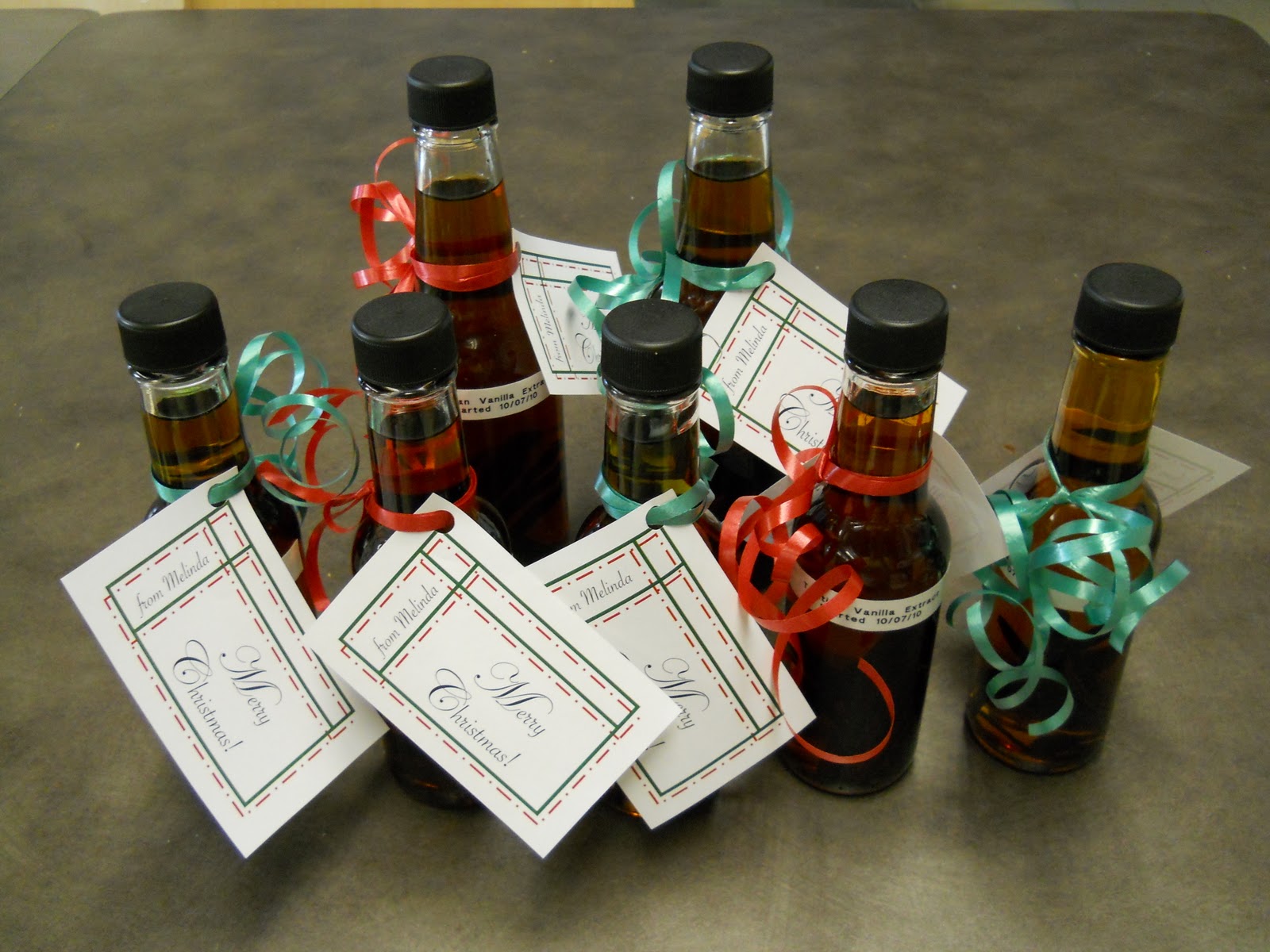 |
| Figure: Labeled and decorated as gifts |

The secretaries loved them - "Oh, these will be perfect for Christmas cookie baking!" one of them exclaimed. The shop guys, on the other hand, were a bit confused. Sort of a, "Thanks, I guess...." was all I got.
But just yesterday one of the shop guys stopped me and said - "My wife says to tell you a big thank you for the vanilla! She's thrilled to have it for baking." So see, I guess that gift just had to find the proper recipient. :)
A Cost Recap:
$19.53 vanilla beans
$27.60 vodka
$20.51 bottles
----------------------
$67.64 Total
That made 5 of 5 oz. bottles, 5 of 10 oz. bottles, an 8.5 oz., 12.5 oz., and a 17 oz. bottle. So that's 113 oz. for $67.64.
So, 60 cents/ounce.
If you buy pure vanilla at the store, it's about $1.06/ounce or $1/ounce, or you can find it even cheaper for 56 cents/ounce plus shipping. So I didn't come out too far ahead in price, but again - that's really not the point.
This project was easy and not time consuming, and got good results, so I'd say I'd do it again - except I now have enough vanilla to last me a lifetime, I suspect. In any case, a success!
Thursday, February 3, 2011
Total Paper Domination
It started, as so many large undertakings do, with a simple problem. I wanted to look up an experimental parameter, and I knew I had seen a paper doing exactly the experiment I wanted to copy.
Could I find that paper? Of course not.
Could I remember that detail? Can Miss Outlier EVER remember a detail?
Clearly there was a problem. I looked for a printed copy of the paper, no luck. In an email? Not so much. Somewhere buried in a folder on my hard drive? Probably.
Before I knew it, I was rounding up ALL the papers I have on my computer - stashed in various folders, "Remember This For PhD," "Related to Useful Experiments," "PhD Exploration" - that have since lost their meaning. I also have a stash of old papers, sort of a lab historical file, that was given to me in a huge zip file from the most senior grad student when I joined the lab. I've always meant to see what was in there, because it would look terribly bad if I forgot to cite one of my own lab's papers. (I did find the paper I was looking for, by the way, it happened to be on my desktop. But at this stage, that was entirely beside the point.)
And then the project got even more involved - because you see, I've always meant to get everything organized in a proper bibliography management software. For my Master's thesis, my strategy was pretty much to find all the papers I could, print them out in a binder, and then refer to them as I wrote Chapter 1: Introduction and Background. I put all the citations for the papers in a BibTeX file, so I could reference them as I wrote the thesis in LaTeX with a Lyx overlay. (If you don't know what that means, it couldn't possibly interest you anyway, don't worry.) So now that I was rounding up all my papers, it was the perfect time to choose a reference software and do things RIGHT.
This, by the way, is classic nerd behavior. I adore Rands in Repose - if you are a nerd, or must deal with one on a daily basis, he is a must read. I'd like to share an excerpt which is relevant in this case:
Finding the paper on the desktop was the First High. But I was on to the Second High - complete paper domination.
I was going to need a system. I had a choice - what software to use? Actually I already had a software, because as I said, I've always meant to organize things. I use Papers - which you have to pay a small amount for, but you get a student price and it is AMAZING. There are a bunch of other options, of course. Here at World's Best School they like you to use RefWorks or EndNote, and a lot of people do just fine with those. Zotero is also useful, and has nice browser plug-ins, and JabRef is used by the open-source crowd.
But I've always felt that what I really want the software to do is keep track of the actual .pdf FILES, not so much the citations. I only need to cite things occasionally when I write articles, but I'd like to have all the information in those .pdfs available for me to easily find on a regular basis. The software Papers does just that - it's first and foremost an organization for your files. (I've been told Mendeley works much the same way, and is free.) It acts like iTunes, where you have all your files in the main library, and then you can make "Playlists," sort of, where you group the papers. So I have a bunch of playlists, for things like People Doing Manufacturing, and People Who Did Cool Stuff But Only Once, and Same Material As Me, and Same Process As Me. And any single journal article can be in as many playlists as you want, without making a physical copy of the file to put in another folder in the hard drive. I also make Smart Playlists, that automatically add files - for instance, Papers My LabMates Wrote - based on authorship in that case.
And of course Papers also ties in to LaTeX, in whatever IEEE or other proper format, so the citation process is quick and painless when I need it.
But the killer feature? Search, baby, search. Because all those files are .pdfs, I can search for a term, and find every single paper I have with that term in it. Even if it's not in the title. Awesome. Especially for papers titled things like, "Microfluidics: A Review". Um, gees, I might need a little more detail.
And I can take notes on each paper, like, "Put in Section 3" and those are searchable too. So when I go to write Section 3 of my article, I can look up all the papers I wanted to include. Or, ahem, "Experimental Parameter for Temperature," so when I go to do experiments, I might be able to find what I need...
So, dear readers, I am pleased to announce that a day a half later, I have gathered every paper I currently have in .pdf form, which is 632. I have populated the proper citation data for all 632 of those papers, and sorted them into meaningful groups (there are 200 that may be relevant to my PhD thesis). And at the end of all that, I did a search for the experimental parameter I was interested in.
And exactly one result popped up - the paper that had once been lost, and prompted the whole organization spree.
I have achieved that Second High, ladies and gentleman - total paper domination.
How do you keep your papers organized? Do you have, or does your lab dictate, a software of choice?
Could I find that paper? Of course not.
Could I remember that detail? Can Miss Outlier EVER remember a detail?
Clearly there was a problem. I looked for a printed copy of the paper, no luck. In an email? Not so much. Somewhere buried in a folder on my hard drive? Probably.
Before I knew it, I was rounding up ALL the papers I have on my computer - stashed in various folders, "Remember This For PhD," "Related to Useful Experiments," "PhD Exploration" - that have since lost their meaning. I also have a stash of old papers, sort of a lab historical file, that was given to me in a huge zip file from the most senior grad student when I joined the lab. I've always meant to see what was in there, because it would look terribly bad if I forgot to cite one of my own lab's papers. (I did find the paper I was looking for, by the way, it happened to be on my desktop. But at this stage, that was entirely beside the point.)
And then the project got even more involved - because you see, I've always meant to get everything organized in a proper bibliography management software. For my Master's thesis, my strategy was pretty much to find all the papers I could, print them out in a binder, and then refer to them as I wrote Chapter 1: Introduction and Background. I put all the citations for the papers in a BibTeX file, so I could reference them as I wrote the thesis in LaTeX with a Lyx overlay. (If you don't know what that means, it couldn't possibly interest you anyway, don't worry.) So now that I was rounding up all my papers, it was the perfect time to choose a reference software and do things RIGHT.
This, by the way, is classic nerd behavior. I adore Rands in Repose - if you are a nerd, or must deal with one on a daily basis, he is a must read. I'd like to share an excerpt which is relevant in this case:
Chasing the Two Highs
The First High: When the nerd sees a knot, they want to unravel it. After each Christmas, someone screws up the Christmas tree lights. They remove the lights from the tree and carefully fold the lights as they lay them in the box. Mysteriously, somewhere between last year’s folding and this year’s Joy of Finding the Lights, these lights become a knotted mess.
The process of unknotting the lights is a seemingly haphazard one — you sit on the floor swearing and slowly pulling a single green cable through a mess of wires and lights and feeling like you’re making no progress — until you do. There’s a magical moment when the knot feels solved. There’s still a knot in front of you, but it’s collapsing on itself and unencumbered wire is just spilling out of it.
This mental achievement is the first nerd high. It’s the liberating moment when we suddenly understand the problem, but right behind that that solution is something greater. It’s….
The Second High: Complete knot domination. The world is full of knots and untying each has its own unique high. Your nerd spends a good portion of their day busily untying these knots, whether it’s that subtle tweak to a mail filter that allows them to parse their mail faster, or the 30 seconds they spend tweaking the font size in their favorite editor to achieve perfect readability. This constant removal of friction is satisfying, but eventually they’ll ask, “What’s with all the fucking knots?” and attack.
A switch flips when your nerd drops into this mode. They’re no longer trying to unravel the knot, they want to understand why all knots exist. They have a razor focus on a complete understanding of the system that is currently pissing them off and they use this understanding to build a completely knot-free product - this is the Second High.
Finding the paper on the desktop was the First High. But I was on to the Second High - complete paper domination.
I was going to need a system. I had a choice - what software to use? Actually I already had a software, because as I said, I've always meant to organize things. I use Papers - which you have to pay a small amount for, but you get a student price and it is AMAZING. There are a bunch of other options, of course. Here at World's Best School they like you to use RefWorks or EndNote, and a lot of people do just fine with those. Zotero is also useful, and has nice browser plug-ins, and JabRef is used by the open-source crowd.
But I've always felt that what I really want the software to do is keep track of the actual .pdf FILES, not so much the citations. I only need to cite things occasionally when I write articles, but I'd like to have all the information in those .pdfs available for me to easily find on a regular basis. The software Papers does just that - it's first and foremost an organization for your files. (I've been told Mendeley works much the same way, and is free.) It acts like iTunes, where you have all your files in the main library, and then you can make "Playlists," sort of, where you group the papers. So I have a bunch of playlists, for things like People Doing Manufacturing, and People Who Did Cool Stuff But Only Once, and Same Material As Me, and Same Process As Me. And any single journal article can be in as many playlists as you want, without making a physical copy of the file to put in another folder in the hard drive. I also make Smart Playlists, that automatically add files - for instance, Papers My LabMates Wrote - based on authorship in that case.
And of course Papers also ties in to LaTeX, in whatever IEEE or other proper format, so the citation process is quick and painless when I need it.
But the killer feature? Search, baby, search. Because all those files are .pdfs, I can search for a term, and find every single paper I have with that term in it. Even if it's not in the title. Awesome. Especially for papers titled things like, "Microfluidics: A Review". Um, gees, I might need a little more detail.
And I can take notes on each paper, like, "Put in Section 3" and those are searchable too. So when I go to write Section 3 of my article, I can look up all the papers I wanted to include. Or, ahem, "Experimental Parameter for Temperature," so when I go to do experiments, I might be able to find what I need...
So, dear readers, I am pleased to announce that a day a half later, I have gathered every paper I currently have in .pdf form, which is 632. I have populated the proper citation data for all 632 of those papers, and sorted them into meaningful groups (there are 200 that may be relevant to my PhD thesis). And at the end of all that, I did a search for the experimental parameter I was interested in.
And exactly one result popped up - the paper that had once been lost, and prompted the whole organization spree.
I have achieved that Second High, ladies and gentleman - total paper domination.
How do you keep your papers organized? Do you have, or does your lab dictate, a software of choice?
Wednesday, February 2, 2011
Cheesecake Bars

Last night I had dinner with a bunch of girls, and we made it a potluck meal. I was immediately struck by how different a girl's potluck night is from a boy's potluck. Last Saturday there was a chili party, and the host sent around a spreadsheet to sign up to bring food. I put down cornbread (seems good with chili, right?). The other guys put down, "cheese." And, "chips." And, of course, "beer."
Last night? One girl brought lamb meatballs with yogurt dipping sauce, another brought scallion pancakes and pork dumplings, and then I made chickpea casserole. For dessert we had white chocolate cheesecake with raspberry topping, and milk tea.
We can debate whether it's okay to stereotype girls as better cooks, and whether these girls are self-selected to be more domestic since they live in a girl's dorm - but here's the bottom line. If you have to pick a potluck to attend, you want to go with the girls. :)
I do have a point to this lengthy intro: the cheesecake was divine. And it inspired me.
Purists will say that cheesecake must be made in a springform pan (and I do have one of those). But I'm lazy, so I thought I'd share some pictures from my recipe file of the last time I made cheesecake. Forget about spring-form and baking in boiling water - this one's not even in a pie shape!
I used this recipe for cheesecake bars. Start by mixing up the crust, reserving some for topping later.
 |
| Figure: Butter sugar flour - what's not to like? |
 |
| Figure: Press in with fingers, preferably as many fingers as possible so you maximize licking them clean. |
The filling is a pretty standard cheesecake filling, which depending on your outlook is either boring, or simple and fast. I generally land on the quick-and-easy philosophy.
 |
| Figure: If you cook by yourself, you get to lick both beaters. Bonus! |

Serve and enjoy!

Subscribe to:
Posts (Atom)